




One wash. That’s all it took for the pattern to blur, the colour to dull, and your beautiful “hand block print” bedsheet to start looking like something off a supermarket shelf.
Here’s the truth: most people can’t tell real hand block print from a clever machine copy. And sellers know it. The good news? You don’t need to be a textile expert. You need thirty seconds and seven things to check.
This guide gives you exactly that, whether you’re holding fabric in a Jaipur showroom or scrolling a product page from your couch in London.
Quick answer:Real hand block print shows small irregularities between motifs, ink pressed into the weave rather than sitting on top, a faint colour halo at the edges, and a visible impression on the reverse side. Machine print looks too perfect, sits flat, and shows nothing on the back.
No Two Prints Are Ever Twins
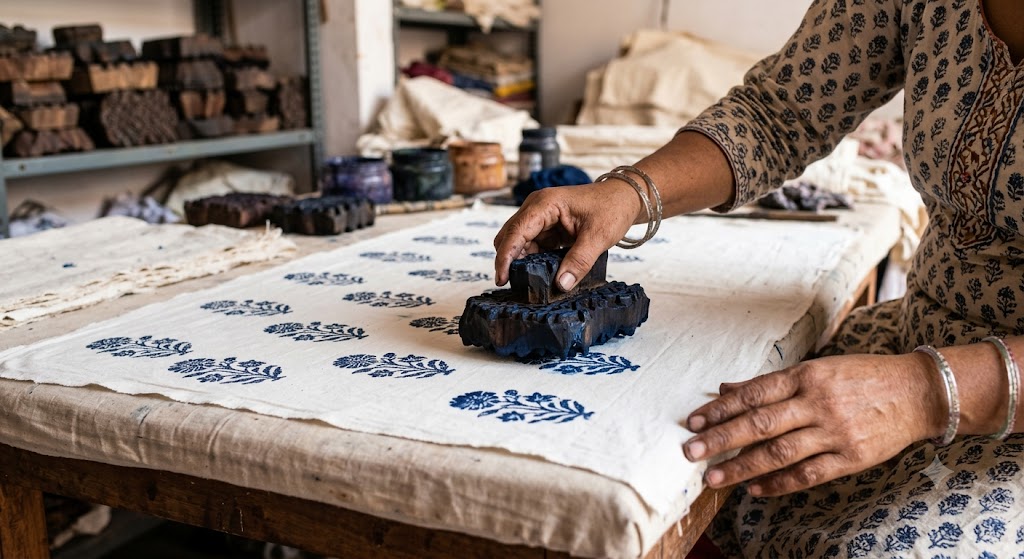
A wooden block is pressed onto fabric by hand, one motif at a time, across the entire length of
cloth. Human hands are not machines. Pressure varies slightly from stamp to stamp.
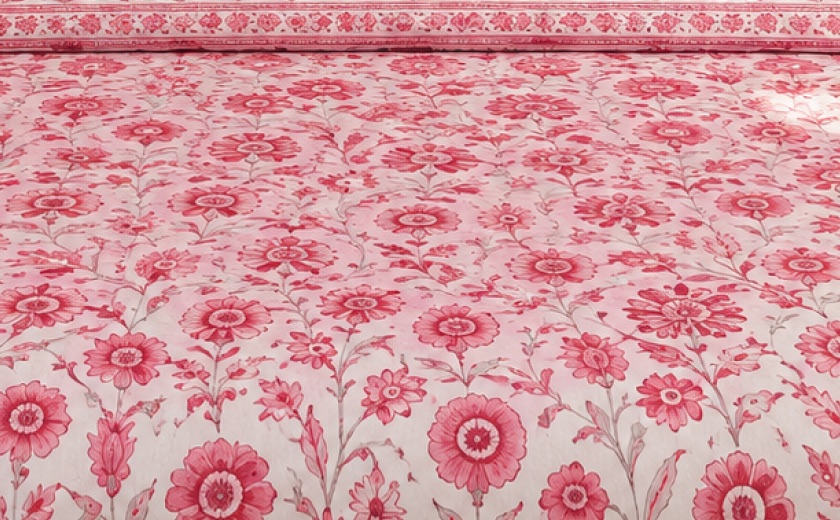
Look closely at any repeating flower or leaf motif. In genuine hand block print, you will find small
differences between one motif and the next.
A petal slightly rotated. A line a shade thicker in one spot. Spacing that is close but never
mathematically identical.
Machine printing uses rollers or digital heads that repeat the same pattern down to the pixel.
If every motif on your sheet looks like a photocopy of the last one, you are looking at a machine
print, not a hand-stamped one.
This is one reason a genuine Sanganeri sheet never looks “perfect” under a magnifying glass.
Perfection, ironically, is the giveaway of a fake.
Run Your Finger Across It. Real Print Has a Story to Tell.
Look for the Halo Around Each Motif
Flip It Over. The Back Tells the Real Story.
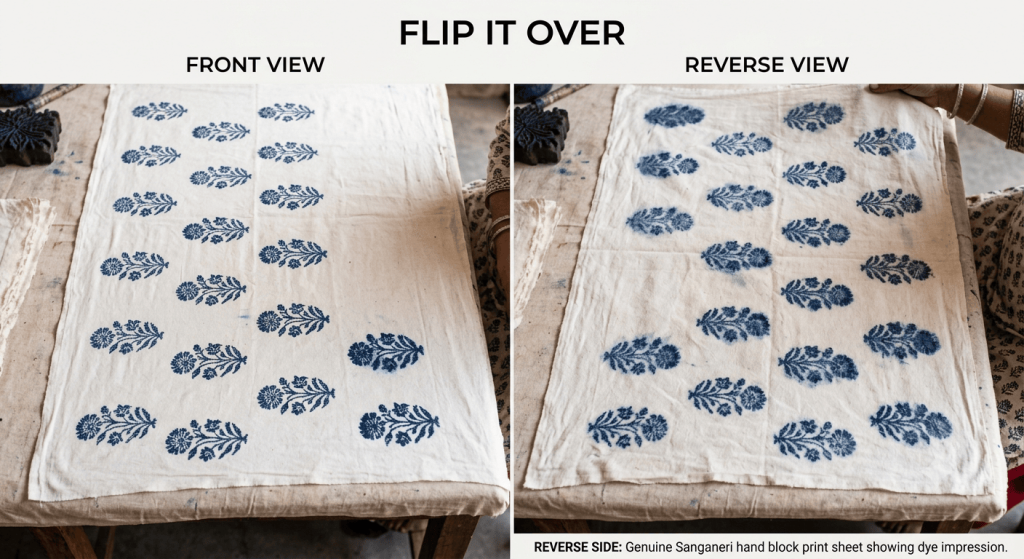
This is the fastest test, and one most buyers never think to do. Turn the fabric over and look at the reverse side.
On genuine hand block print, you will usually see a soft, visible impression of the pattern on the back, sometimes lighter in colour, sometimes just a faint shadow of the motif.
This happens because the dye is pressed through the fabric, not printed on only one side.
On machine-printed fabric, the back is almost always completely plain white or a single flat colour, with no trace of the pattern at all.
If you flip your sheet over and see nothing, that is a strong sign the print was applied by machine.
Trust Your Nose Before You Trust the Tag
Small Imperfections in the Weave Are a Good Sign
Hand block printing puts real physical pressure on fabric, block after block, for hours.
This can leave slight, almost invisible texture variations in the weave, especially on finer fabrics like mul-mul cotton.You are not looking for damage or flaws that affect the sheet’s quality. You are looking for the natural signature of something made by hand, not run through a machine at high speed with zero variation.
If the fabric feels uniformly machine-smooth across every inch with zero texture variation anywhere, that uniformity itself is a clue.
If the Price Feels Too Good, It Probably Isn't Real
This is the sign most buyers ignore, and the one that matters most.
A genuine hand-block-printed sheet takes real time.
Skilled artisans carve wooden blocks, mix dyes, and stamp fabric by hand, often over several days for a single piece, according to the Association for Indian Artisans and Craftspeople. That time and skill have a cost.
If a “hand block print” bedsheet is priced the same as a plain machine printed cotton sheet from a mass retailer, in India or abroad, it is very unlikely to be genuinely hand-stamped.
Authentic craft has a price floor that machines simply do not have.
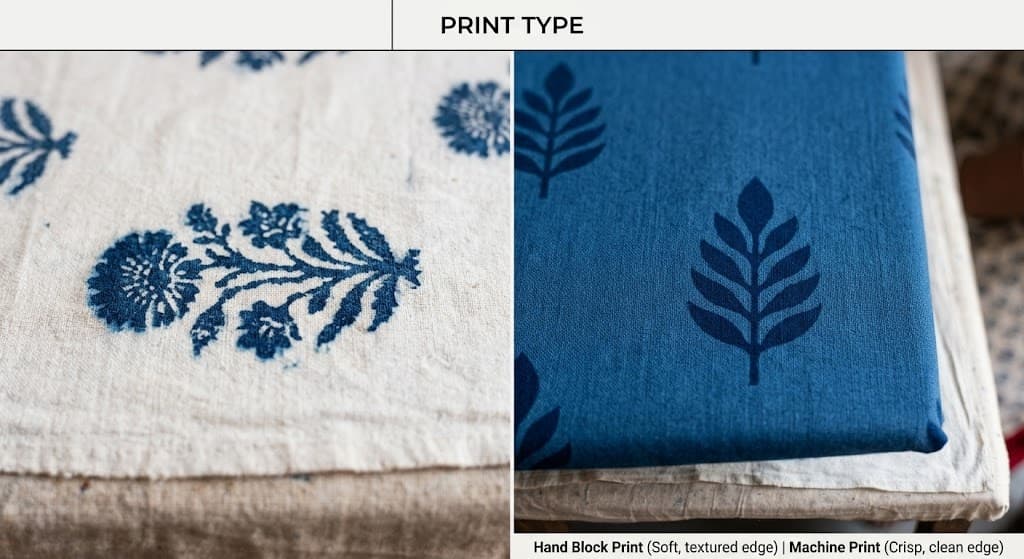
Hand Block Print vs Machine Print: A Quick Comparison


Why Fake Hand Block Print Exists in the First Place
It is worth understanding why this confusion happens, rather than assuming bad intent everywhere. Genuine hand block printing is slow and limited in volume.
A single artisan can only stamp so many metres of fabric in a day.
Demand for the look of block print, especially the boho and artisan aesthetic popular in home décor right now, has grown much faster than the supply of skilled hand-block artisans.
Machine printing fills that gap by imitating the visual style at scale and at a lower price.
There is nothing wrong with a printed cotton sheet sold honestly as printed cotton.
The problem is when it is sold as hand block print when it is not. Knowing the seven signs above protects you either way.
The Craft Behind the Cloth
Sanganeri hand block printing carries a Geographical Indication (GI) tag, granted in 2010, which legally recognises it as a craft tied specifically to Sanganer town near Jaipur.
At one point, more than 300 registered printing units operated in and around Sanganer alone, according to the GI application filed by the Calico Printers Co-operative Society.
That is a lot of skilled hands, and it is also exactly why authenticity checks matter. A craft with this much history deserves buyers who can tell the real thing from an imitation.
Frequently Asked Questions
Is hand block print fabric washable?
Yes. Hand block print fabric is fully washable, though it is best hand-washed or machine-washed in cold water with mild detergent to protect the natural or reactive dyes and keep colours looking fresh for longer.
Why is hand block print more expensive than printed cotton?
Hand block print takes significantly more time and skilled labour to produce than machine printing, since each motif is stamped by hand rather than run through an automated roller or digital printer at high speed.
Can hand block print be 100% cotton?
Yes. Most traditional hand block print, including Sanganeri print, is done on pure cotton fabrics like mul-mul, voile, and cambric, which take natural and reactive dyes particularly well.
How long does hand block printing take per sheet?
Depending on the number of colours and the complexity of the design, a single hand block printed piece can take anywhere from a few hours to several days to complete, according to craft documentation from AIACA.
Does hand block print fade faster than machine print?
Not when cared for properly. Genuine hand block print, especially with natural dyes, can actually hold its character well over years of washing, though it should be washed in cold water and kept out of direct harsh sunlight to preserve colour.
Bring the Real Thing Home
Now that you know what to look for, you don’t have to guess anymore.
Every sheet in our Sanganeri Bedsheet Collection is hand-stamped by artisans in Sanganer, and every piece carries the small, honest imperfections that prove it.
Want to go deeper into the craft? Read Sanganeri vs Bagru vs Ajrakh:
What’s the Difference? or explore Natural Dyes of Rajasthan to see exactly what goes into every colour you find on our fabric.